



When ASEAN leaders adopted the Master Plan on ASEAN Connectivity 2025 (MPAC 2025) in Vientiane in September 2016, they set out a clear ambition: to achieve a seamlessly and comprehensively connected ASEAN that promotes competitiveness, inclusiveness, and a stronger sense of community. A decade on, that ambition has been tested against real-world outcomes.
A decade-long blueprint for a better-connected region
MPAC 2025 was not ASEAN’s first blueprint for connectivity. It was built on the earlier Master Plan on ASEAN Connectivity 2010, which first gave the region a structured framework for pursuing closer links across its Member States. MPAC 2025 sharpened the focus, anchoring the connectivity agenda around five strategic areas: Sustainable Infrastructure, Digital Innovation, Seamless Logistics, Regulatory Excellence, and People Mobility. Under these five areas, 15 initiatives and 143 Key Implementation Measures (KIMs) were identified, each with a designated lead body to drive progress.
Crucially, MPAC 2025 was designed with implementation in mind. Governance, ownership, and alignment were built into the plan from the outset as a response to the lessons learnt from its predecessor, setting up a framework through which ASEAN Member States and sectoral bodies could work together towards the connectivity vision.
The context in which the implementation of MPAC 2025 progressed was anything but straightforward. The COVID-19 pandemic affected progress across every area of cooperation. Accelerating digitalisation, supply chain shocks, geopolitical shifts, a growing imperative for inclusivity and sustainability, and widening development gaps within and across Member States shaped what was possible in delivering the region’s achievements.
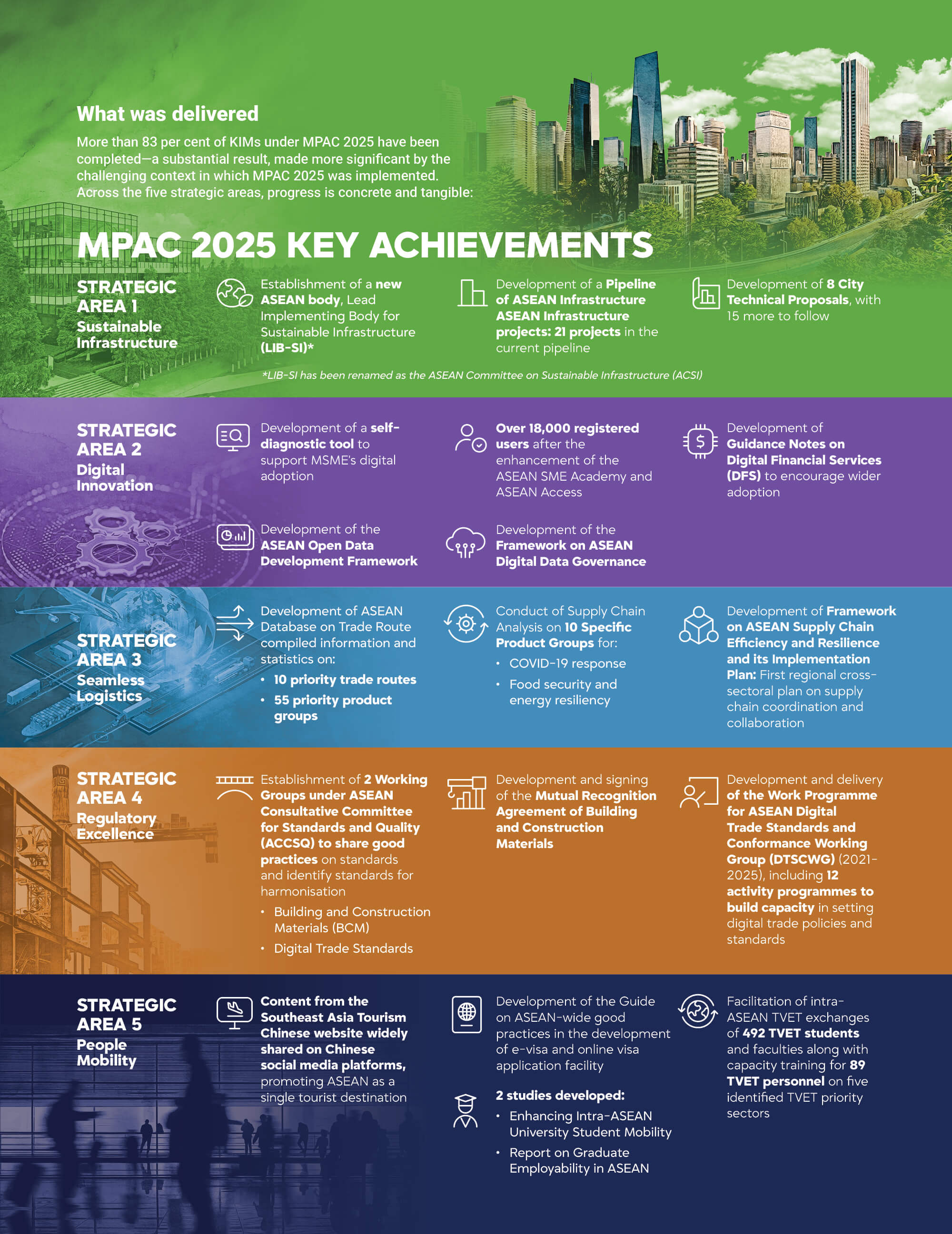
Honest lessons
The ETR does more than just count achievements. It provides an honest accounting of where implementation fell short of MPAC 2025’s ambitions and why. These findings are presented not as failures but as practical lessons that strengthen and ground the region’s next connectivity plan.
Coordination across sectors proved consistently challenging. With 15 initiatives spanning multiple ministries, agencies, and bodies across the then ten Member States, keeping all parts of the machinery aligned was genuinely difficult. Ownership, which MPAC 2025 had explicitly prioritised from the start, was uneven in practice. Where a clear champion existed for an initiative, progress tended to be stronger; where responsibility was more diffuse, momentum was harder to sustain.
Awareness of the MPAC 2025 agenda was not always consistent among those responsible for implementing it, particularly at the national level. Engagement with the private sector, which plays a critical role in financing and delivering connectivity projects, has room to grow. Capacity also varied across Member States, affecting the pace and quality of implementation in some areas. And the financing available, while significant, was not always structured with the flexibility needed to respond to the rapid changes the region experienced over the decade.
Taken together, these are the realities of implementing an ambitious programme across diverse economies with different capacities and priorities. The ETR’s contribution is to document these challenges clearly. Progress depends on knowing what worked, what did not, why, and how to address them in the next plan.
The ACSP: A more resilient roadmap
The ASEAN Connectivity Strategic Plan, developed as the successor to MPAC 2025, reflects these lessons directly. It expands on its predecessor in scope, encompassing six strategic areas, 14 objectives, and 47 strategic measures. Smart and Sustainable Urban Development has been added as a standalone strategic area, recognising the importance of sustainable urbanisation and the ASEAN Smart Cities Network’s contribution. Two additional strategic measures are dedicated to the ASEAN Outlook on the Indo-Pacific (AOIP), reflecting the importance of ASEAN’s engagement with partners beyond the region.
The more significant changes lie in how the ACSP is designed to be implemented. Greater clarity on ownership, with specific lead bodies and supporting bodies identified for each strategic measure, directly addresses one of the ETR’s most consistent findings. The ACSP’s work plan is being developed with an explicitly agile and adaptive approach. Rather than a fixed set of activities for the decade ahead, it builds in the capacity to respond to changes in the region’s needs and priorities over time. Cross-pillar coordination with the Strategic Plans of the ASEAN Political-Security Community, ASEAN Economic Community, and ASEAN Socio-Cultural Community is also a more deliberate feature of the ACSP than it was of MPAC 2025.
The ACSP also places a stronger emphasis on stakeholder engagement and participation, including with the private sector, civil society, academia, and ASEAN’s dialogue partners, recognising that connectivity cannot be delivered by governments alone. All of these sit within the frame of the ASEAN Community Vision 2045, which charts the region’s course toward becoming a Resilient, Innovative, Dynamic, and People-Centred community.

Looking ahead
Connectivity is ultimately not about plans and measures. It is about a student crossing a border to study, a small business owner accessing a digital marketplace, and a family travelling more easily between ASEAN countries. The ETR of MPAC 2025 confirms that real progress was made in these areas over the past decade, alongside an honest account of where the region can do better.
The ACSP takes on these lessons on board and forward. With a broader strategic framework, stronger institutional foundations, and a built-in commitment to agility and partnership, it offers the region a more resilient vehicle for the connectivity journey ahead. The road to 2045 is long, and the challenges are real, but ASEAN moves forward with both ambition and experience on its side.