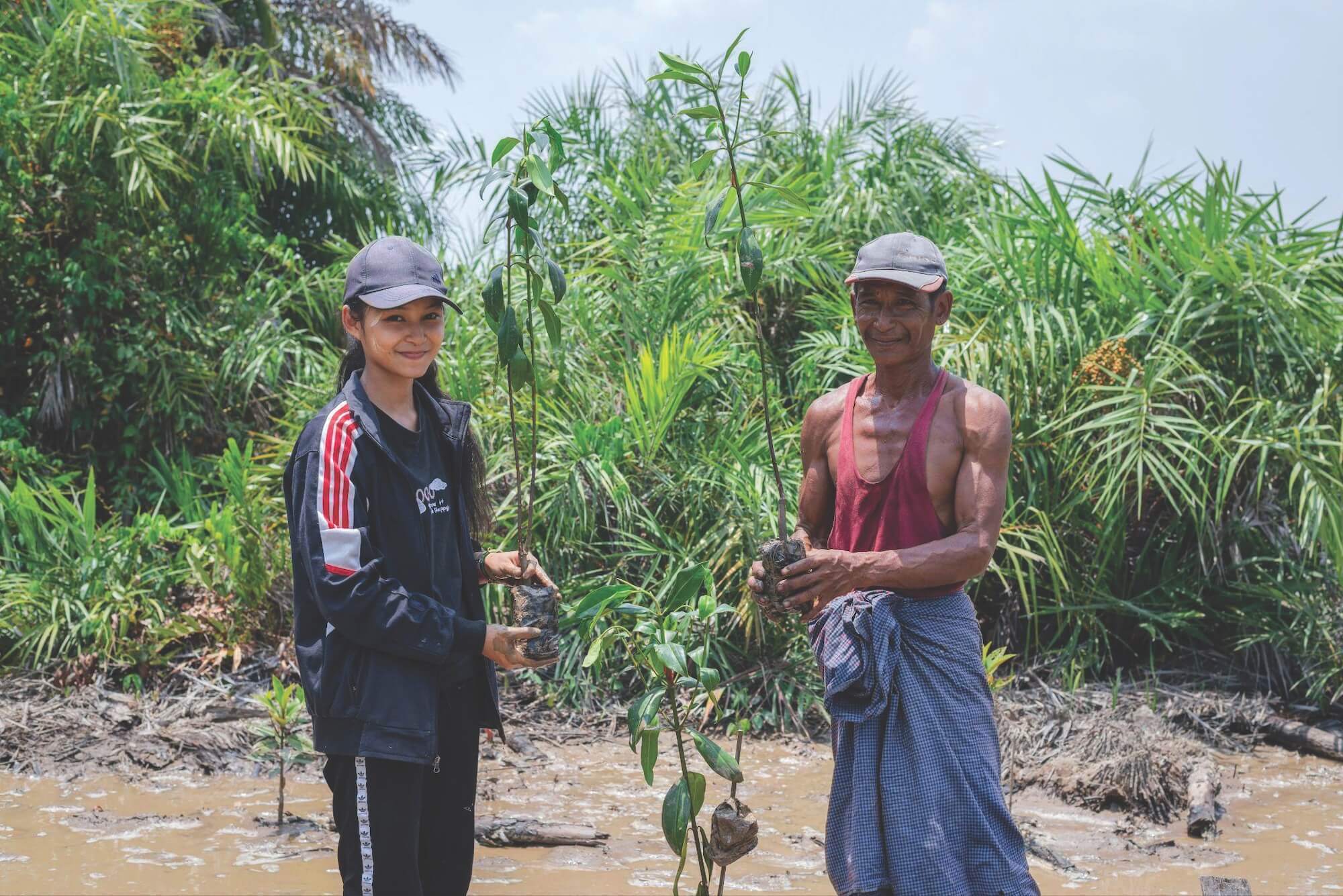
Amid the coastal wetlands of Myanmar, villagers stand ankle-deep in sticky mud, relentlessly digging holes to plant the mangrove saplings they have nurtured for months. This scene has become a familiar sight in Bogale town, where local communities are at the forefront of restoring the once-dwindling mangrove forest in Meinmahla Kyun Wildlife Sanctuary (MKWS)—a Ramsar site and one of Myanmar’s ASEAN Heritage Parks (AHPs) supported by the Small Grants Programme (SGP) of the ASEAN Centre for Biodiversity.
“We trained local people from 12 rural villages to improve their capacity in mangrove planting, specifically on nursery establishment, high-value planting methods, mixed farming methods, among others,” says Tun Tun Zaw, Programme Officer of the Myanmar Environment Rehabilitation-conservation Network (MERN), a grantee of SGP in Myanmar.
Across Southeast Asia, similar initiatives have taken root in collective efforts to protect biodiversity while transforming the lives of local communities in and around select AHPs in Indonesia, Myanmar, and Viet Nam. AHPs are outstanding protected areas in the ASEAN region that have been recognised for their high conservation value and ecological diversity.
A community-led and driven initiative
One of ASEAN Centre for Biodiversity’s flagship and long-standing programmes, the SGP was implemented in two phases with the support of the Federal Republic of Germany through the KfW Development Bank. The first phase (SGP I) was launched in 2014, focusing its interventions on six AHPs in Indonesia and Myanmar, while the second phase (SGP II) was launched in 2017 with special emphasis on four AHPs in Viet Nam.
At the core of the programme are micro- and small-grants awarded to projects that enhance wildlife monitoring and protection, build the capacity of park authorities, foster conservation awareness and community engagement, and promote ecotourism and community-led livelihood value chains.
Conservation above all
The ASEAN region is renowned for its rich natural resources, cradling four biodiversity hotspots and three megadiverse countries. Through SGP I and II, several initiatives contributed to improving biodiversity conservation in the region.
By means of MERN’s mangrove restoration efforts, local authorities and 12 village communities restored over 720 hectares of mangroves in Meinmahla Kyun Wildlife Sanctuary, with a number of community nurseries producing 193,770 seedlings of 18 mangrove species.
In Viet Nam, SGP II assisted Frankfurt Zoological Society (FZS) in improving wildlife research and monitoring of key primate and ungulate species—including the Grey-shanked Douc Langur (Pygathrix cinerea), Northern Yellow-cheeked Gibbon (Nomascus annamensis), and Truong Son Muntjac (Muntiacus truongsonensis). As a result, one distribution map assessing the species population was produced, and park staff of Kon Ka Kinh National Park (KKKNP) were trained to carry out effective wildlife monitoring using camera traps and other essential equipment provided by the programme.
In Indonesia’s Way Kambas National Park (WKNP), SGP I helped address human-elephant conflicts through GPS tracking and joint forest patrols conducted by park authorities and local communities. Complementing this effort, the Kelompok Sadar Wisata (Tourism Awareness Group), or POKDARWIS, developed ecotourism packages—including community organisations in the picturesque village of Braja Harjosari—that offer tourists 12 unique activities, such as agrotourism, birdwatching, night safari, cultural shows, and elephant feeding.
By integrating elephants into the tourism experience, communities began to take an interest in their welfare, viewing them not as threats but as allies in development. This shift has helped transform tourism in WKNP from traditional mass tourism into a socialised, community-driven ecotourism model that promotes meaningful interaction with elephants.
Providing biodiversity-friendly livelihood alternatives
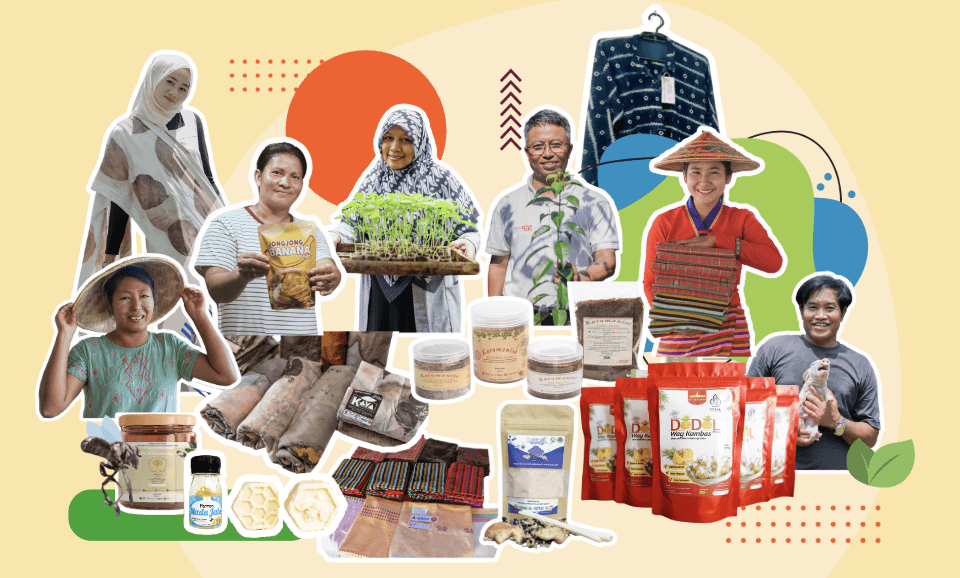
SGP I and II promoted sustainable development by supporting community-based livelihoods that align income generation with biodiversity conservation and the sustainable use of natural resources.
By investing in agroforestry, fisheries, ecotourism, and livelihood value chains, the programme helped ease pressures on the national park resources while empowering the community, including ethnic groups, women, and youth, to take an active role in their own development.
This is evident in the simple livelihood project in Gunung Leuser National Park (GLNP) that led to the formation of Kaya Ecoprint. This women-led enterprise designs a range of materials using natural pigments from various plants. With these natural dyes, the women craft unique and intricate designs in clothes, shawls, bags, and other fabrics and non-textile materials.
Similarly, the women from the Tày ethnic group in the buffer zone of Hoang Lien National Park (HLNP) have showcased their vibrant cultural traditions and their deep appreciation for biodiversity through ancestral crafts—producing textiles featuring nature-inspired motifs coloured with natural indigo. This tie-dye practice now serves as their important income source.
“After participating in the project, I learned how to draw and design patterns inspired by plants, birds, and monkeys in Hoang Lien. Because of the new designs, I can sell them at a higher price. For example, scarves that used to sell for 100,000 Vietnamese dong can now be sold at 150-200,000 Vietnamese dong,” shares Ma Thi May, group member of Thu cong Hoang Lien.
The SGP supports the production of biodiversity-based products to provide additional income to local communities and reduce pressure on national parks.
To date, the products of Kaya Ecoprint and Thu cong Hoang Lien have reached wide markets through e-commerce training, which developed the women’s capacity to use social media to market their products online successfully.
Ecotourism has also been a key focus of SGP II’s support in Viet Nam. The iconic Ba Be Lake, along with 37 other scenic spots and tourist attractions, five biodiversity sites, and 50 tourism and culinary services, all found in Ba Be National Park, are featured on a virtual reality website that allows visitors to explore destinations and book their visits in advance.
In HLNP, five new tourism routes were introduced, bringing the total to eight tourism routes available to visitors. Signages and maps were also installed throughout the park to support visitors’ navigation. These improvements have enabled park management to apply for recognition as a provincial-level tourist area, thereby attracting more visitors and increasing the park’s revenues.
Beyond tourism, the investments also supported the development of more than 60 biodiversity-based products, ranging from food items like honey, banana chips, green tea, turmeric powder, ginger lemongrass drink, pineapple dodol, to agricultural products such as organic rice and vegetables, salted eggs, and meat products from duck and chicken, as well as marine products like shrimp paste, shredded fish, and fish nuggets.
The honey production project in Sa Thay commune, a buffer zone of Chu Mom Ray National Park, led to the establishment of a cooperative that supports 15 members with training on beekeeping techniques, honey production, and marketing. With the economic benefits and greater awareness, the cooperative members have become even more motivated to safeguard the forest and their livelihood.
“Since the cooperative provided me with beehives, I no longer go into the forest to collect wild honey, because it required climbing large tree branches and was very dangerous. I stay at home to take care of these beehives, as they have created additional income for my family’s livelihood, and gradually I have come to love and develop a passion for these bees,” says Ho Quoc Viet, a member of the Sa Thay Commune Beekeeping Cooperative.
Sustaining the gains: A lasting legacy of the SGP
To sustainably support mangrove restoration, MERN established a revolving fund in 12 villages to finance livelihood activities such as crab, goat, and duck farming. The fund provided seed capital to community members, which is repaid with interest to support the livelihoods of additional households and reinvest in the continuous mangrove restoration efforts.
On the other hand, various projects are finding ways to continue by seeking other funding opportunities. “After SGP II ends, IDEA will continue accompanying the cooperative groups in promoting their products, while simultaneously seeking additional funding sources to support and further develop the group,” says Nguyen Thu Huong, Project Coordinator of the Centre for Research and Action for Inclusive Development.
From restoring degraded forests to developing biodiversity-based livelihoods, the wealth of best practices and lessons learned from SGP I and II contribute to the overarching national and regional targets, offering other AHPs with models to follow.
“The SGP created a network of different sectors where knowledge, challenges, and lessons can be exchanged. These lessons from the programme implementation can be carried over to other AHPs undergoing similar contexts,” explains Ms. Corazon De Jesus, Jr., Acting Director of the Programmes Department and Director of the Sustainable Use and Access and Benefit-Sharing Division of the ACB.
After more than a decade of implementation, the small seeds planted by the phases of SGP have grown into a tree yielding long-term benefits for communities. But the rewards can even be far-reaching through the sustained collaboration between communities and park management to ensure that gains extend beyond the project life cycle.
“Although implemented over a relatively short period, the long-term value is significant. Beyond immediate results, the skills and knowledge gained through SGP II support will continue to serve as a foundation for subsequent target programmes supporting the Management Board of Kon Ka Kinh National Park,” explains Nguyen Ai Tam, Project Area Manager of FZS.
Ultimately, the projects espoused by the SGP have transformed not only the AHPs but also the people, as they become the heroes and stewards of their environment, achieving lasting impact for people and nature.