

When the world’s leaders adopted the United Nations 2030 Agenda for Sustainable Development in 2015, they set an ambitious goal of achieving prosperity that leaves no one behind. In that same year, ASEAN adopted the ASEAN Community Vision 2025, charting a regional pathway towards a peaceful, stable, and resilient community.
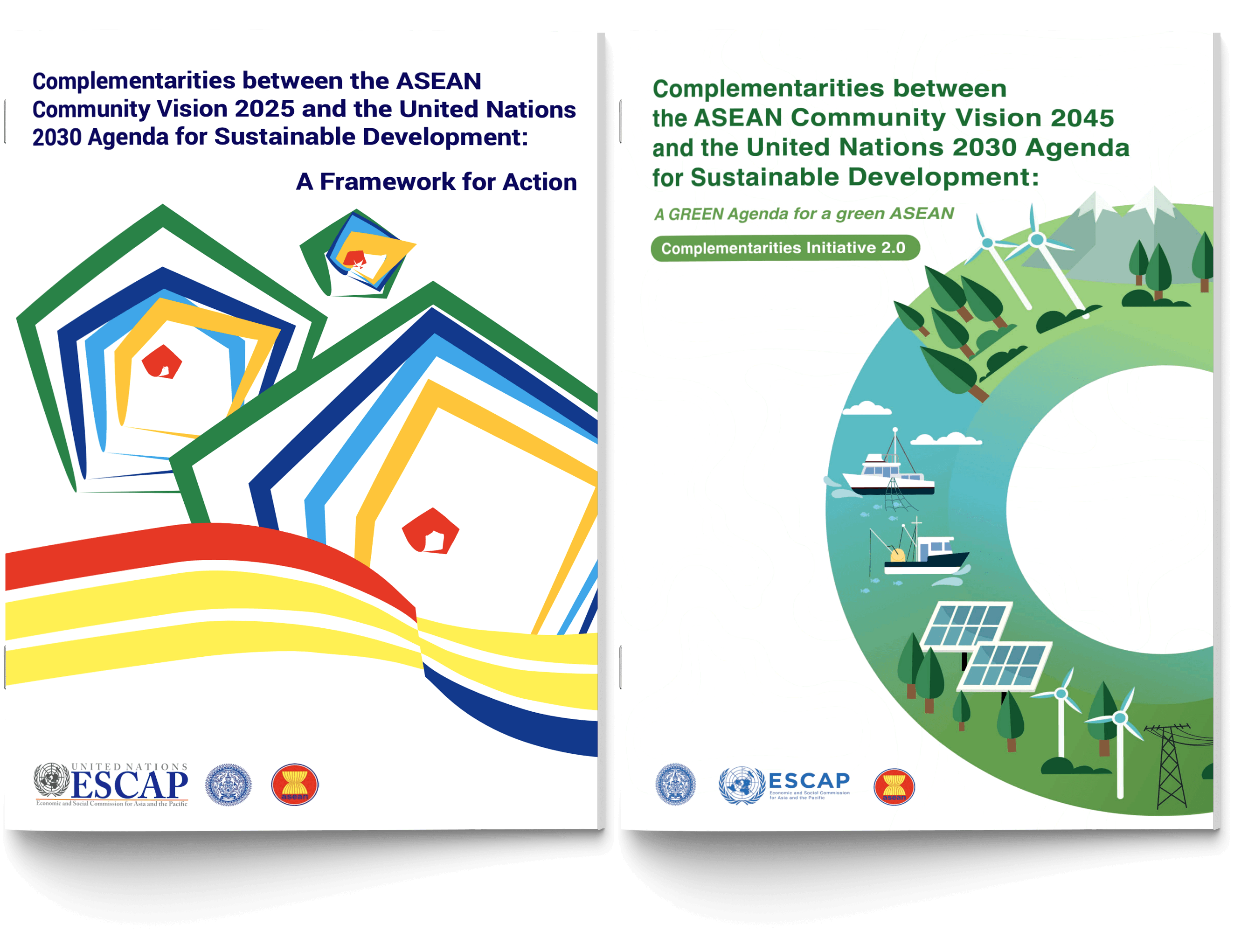
These two visions, one global and one regional, share the same heart—a belief that development must balance economic growth with environmental responsibility. Recognising this shared purpose, in 2017 Thailand, in its capacity as the ASEAN Coordinator for Sustainable Development Cooperation, in collaboration with the United Nations Economic and Social Commission for Asia and the Pacific (UNESCAP) and the ASEAN Secretariat, developed the Complementarities between the ASEAN Community Vision 2025 and the United Nations 2030 Agenda for Sustainable Development, or the Complementarities Initiative (CI). The Initiative aimed to provide synergy that connects ASEAN’s regional priorities with the global development agenda, reaffirming that ASEAN’s and the world’s progress are interconnected.
A renewed vision for a changing world
Eight years later, the world has changed profoundly. The impacts of climate change, digital disruption, and widening inequality are reshaping societies and testing the resilience of nations. Against this backdrop, ASEAN also moves toward its new long-term vision, the ASEAN Community Vision 2045, which envisions a “green ASEAN” that is sustainable and resilient.
To support this vision, Thailand, in collaboration with UNESCAP and the ASEAN Secretariat, developed the Complementarities between the ASEAN Community Vision 2045 and the United Nations 2030 Agenda for Sustainable Development, or the Complementarities Initiative 2.0 (CI 2.0), building on the lessons of its first edition. The CI 2.0 reaffirms ASEAN’s collective commitment to sustainable development, ensuring that regional priorities remain aligned with global goals, while demonstrating the region’s resolve to address emerging challenges and to ensure that sustainability remains a cornerstone of ASEAN’s community-building journey.
A GREEN agenda for ASEAN
At the heart of CI 2.0 lies a set of five cross-cutting priority areas, collectively known as the GREEN Agenda:
- Green Finance,
- Resilience against Climate Change,
- Energy Transition,
- Effective Digital Transformation, and
- Networking and Partnerships
All of these priorities are interconnected, forming a holistic framework for how ASEAN can pursue growth that is environmentally and socially just.
Under Green Finance, ASEAN seeks to mobilise resources for sustainable infrastructure and projects that enable a just transition to a low-carbon economy. Initiatives such as the ASEAN Taxonomy for Sustainable Finance and the ASEAN Catalytic Green Facility (ACGF) illustrate the region’s shared effort to direct public and private capital toward green transformation. Yet, challenges remain. Ensuring equitable access to finance across all Member States, enhancing financial literacy, and attracting investment from partners are essential to making green growth inclusive for all.
Resilience against Climate Change is another key pillar. The region continues to experience climate-induced disasters, from typhoons and droughts to rising sea levels that threaten coastal communities. ASEAN’s efforts to strengthen resilience include the establishment of the ASEAN Centre for Climate Change in Brunei Darussalam, which serves as a hub for regional data sharing, research, and policy coordination. The CI 2.0 also encourages Member States to adopt nature-based solutions and integrate climate adaptation into national and regional planning.
Energy Transition stands as another pillar of this transformation. As energy demand in ASEAN grows, the shift to cleaner energy sources will be key to reducing greenhouse gas emissions while creating opportunities for innovation and green jobs. CI 2.0 encourages ASEAN to strengthen regional connectivity, support technology transfer, and deepen cooperation to ensure that the energy transition is both just and inclusive, supported by a clear roadmap that provides institutional and financial frameworks for renewable power integration.
Meanwhile, Effective Digital Transformation plays a crucial role as both an economic driver and an enabler of sustainability and regional integration. Digital technologies can optimise energy use, improve resource efficiency, and enhance the monitoring of environmental and social outcomes. The CI 2.0 calls for narrowing the digital divide, promoting digital literacy, and ensuring that digital transformation benefits everyone, especially vulnerable communities.
Finally, Networking and Partnerships remain at the heart of ASEAN’s sustainable development journey. The CI 2.0 exemplifies the power of collaboration among ASEAN Member States, with external partners, and across governments, the private sector, and civil society. By fostering inclusive, and multi-stakeholder partnerships, the CI 2.0 seeks to effectively translate regional aspirations into concrete actions effectively, ensuring that the ASEAN Community Vision 2045 and the 2030 Agenda for Sustainable Development are implemented inclusively across the region.
From vision to action
The endorsement of CI 2.0 at the 15th ASEAN–UN Summit in Kuala Lumpur on 27 October 2025 marks an important milestone that reaffirms the region’s strong commitment to the ASEAN–UN partnership and the global development agenda. It is Thailand’s hope that this endeavour will inspire further dialogue and concrete cooperation within ASEAN, between ASEAN and external partners, and across the wider international community.
Building on this momentum, the CI 2.0 proposes a set of actions to accelerate progress on the SDGs. These include enhancing regional financing mechanisms for sustainable projects, operationalising the ASEAN Centre for Climate Change, strengthening SDG data systems and regional indicators, and promoting cross-sectoral synergy among ASEAN’s sustainability-related bodies. Through these efforts, ASEAN aims to deliver tangible benefits to its people, creating jobs, enhancing resilience, and promoting environmental stewardship, while ensuring that no one is left behind.

A shared future for a sustainable ASEAN
For Thailand, the CI 2.0 embodies our enduring belief in partnership and cooperation. As the ASEAN Coordinator for Sustainable Development Cooperation, Thailand remains committed to working closely with all partners to deliver concrete outcomes that advance sustainable, inclusive socio-economic development.
Looking towards 2045, ASEAN aspires to be a resilient, innovative, dynamic, and people-centred community, with sustainability underpinning all three pillars of the ASEAN Community. The CI 2.0 serves as a tool to navigate this journey, aligning regional actions with global goals and guiding ASEAN towards a future where sustainable and inclusive development empowers its people and safeguards the planet we all share.
The views and opinions in this article are solely those of the author and do not represent the policy or official position of ASEAN.