
Introduction
In 2015, the ASEAN Community, composed of three Pillars—ASEAN Political-Security Community (APSC), ASEAN Economic Community (AEC), and ASEAN Socio-Cultural Community (ASCC)—was established with the adoption of the Kuala Lumpur Declaration on the Establishment of the ASEAN Community by the ASEAN Leaders during the 27th ASEAN Summit.
To guide ASEAN’s Community-building from 2015 until 2025, the ASEAN Leaders adopted the ASEAN 2025: Forging Ahead Together, which contains the ASEAN Community Vision 2025 and the Blueprints of the three pillars of the ASEAN Community.
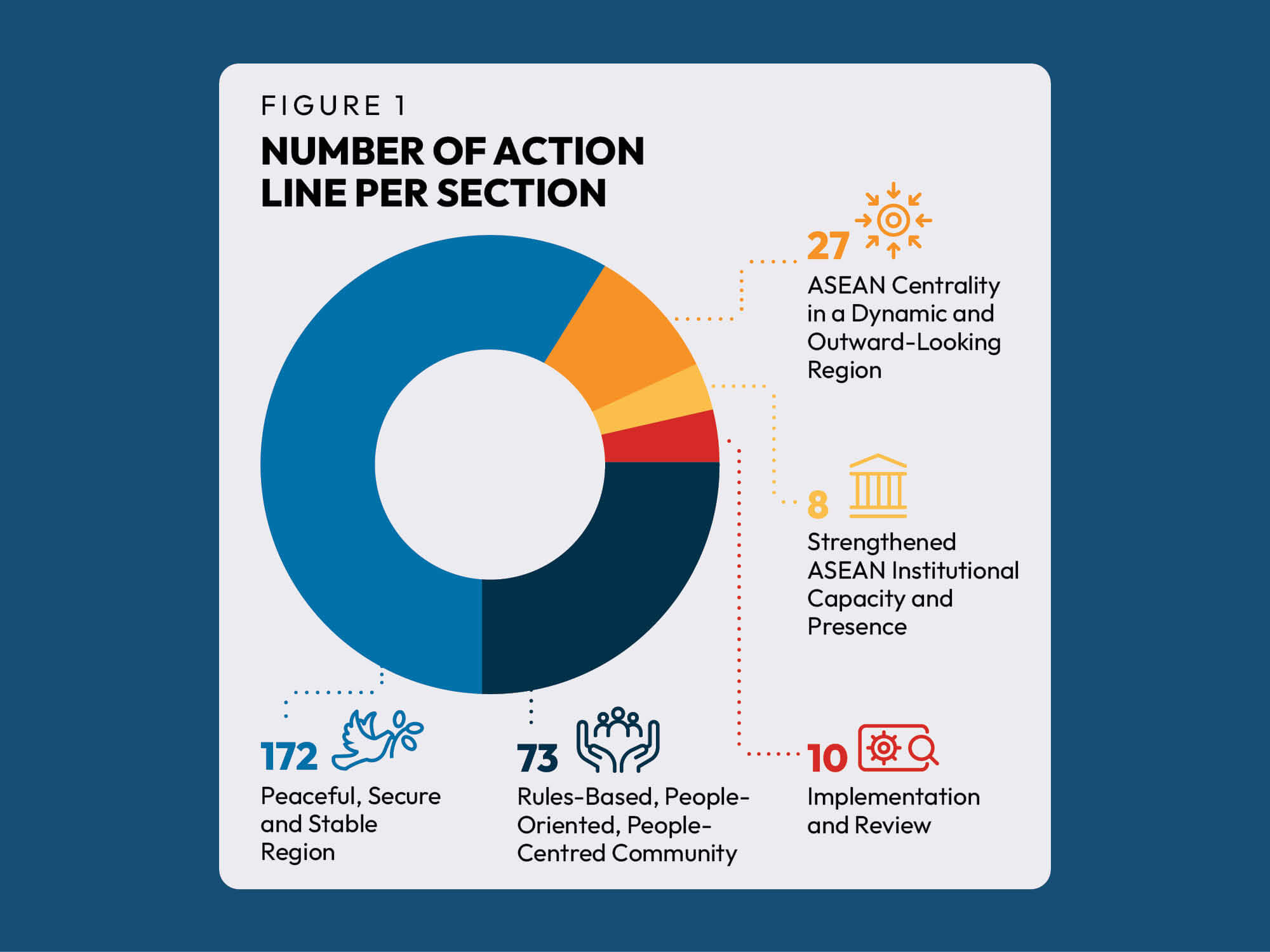
The APSC Blueprint 2025 is composed of five sections: (1) rules-based, people-oriented, people-centred community; (2) peaceful, secure and stable region; (3) ASEAN Centrality in a dynamic and outward-looking region; (4) strengthened ASEAN institutional capacity and presence; and (5) implementation and review. The 290 action lines of the Blueprint are distributed across these sections, as shown in the Figure 1. By year-end 2025, the implementation rate of the APSC Blueprint 2025 reached 99.6 per cent, with 289 of the action lines acted upon.
Achieving the goals of the APSC Blueprint 2025
The APSC Blueprint 2025 was meant to contribute to achieving the following goals: (i) a rules-based, people-oriented, people-centred community, (ii) a peaceful, secure and stable region, (iii) ASEAN Centrality, and (iv) a strengthened institutional capacity.
During the 17th ASEAN Coordinating Conference for Political Security Community (ASCCO), there was the view that the most achieved goal is “fostering a peaceful, secure, and stable region,” with this goal having seen “significant progress.” ASEAN has advanced politically sensitive agenda, including the South China Sea. It has played a crucial role in maintaining overall regional stability, preventing disputes from escalating into wider armed conflict, and advancing confidence-building measures through dialogues under ASEAN-led mechanisms.
There is another set of views that the goal of a strengthened ASEAN’s institutional capacity has been the most achieved: “[o]ver the years, ASEAN has not only advanced cooperation in diverse priority areas but has been flexible in approaches and modalities to address urgent and emerging issues.” Amidst challenges encountered in enhancing ASEAN’s institutional capacity and effectiveness, there is consensus that since 2015, when the Blueprint’s implementation commenced, ASEAN’s institutional capacity has improved, although in the words of one ASEAN Member State, “modestly improved.” Nonetheless, “while there has been some progress, the demands of an increasingly complex regional environment require more agile, better resourced, and better coordinated mechanisms.”
Assessing the implementation of the APSC Blueprint 2025
In assessing the implementation of the APSC Blueprint 2025, specifically the 1,492 activities which have been recorded as implementing the various action lines, the following parameters were used: (i) extent – whether an activity has contributed in attaining the APSC pillar goal, the overall ASEAN Community-building goal or both; (ii) impact – the magnitude of an activity’s contribution in attaining the goals the APSC pillar or the ASEAN Community; (iii) sustainability – the possibility of the activity being continued; (iv) duration – the period of time when the effect of the activity could be felt; (v) irreversibility – possibility that the activity’s effects could be undone; and (vi) probability – the chance of the intended effect happening.
On extent, almost half (47%) of the activities were viewed as having contributed to the goal of the APSC pillar. Thirty-eight per cent (38%) were evaluated to have contributed to the overall goal of ASEAN Community-building, and 16 per cent contributed to both.
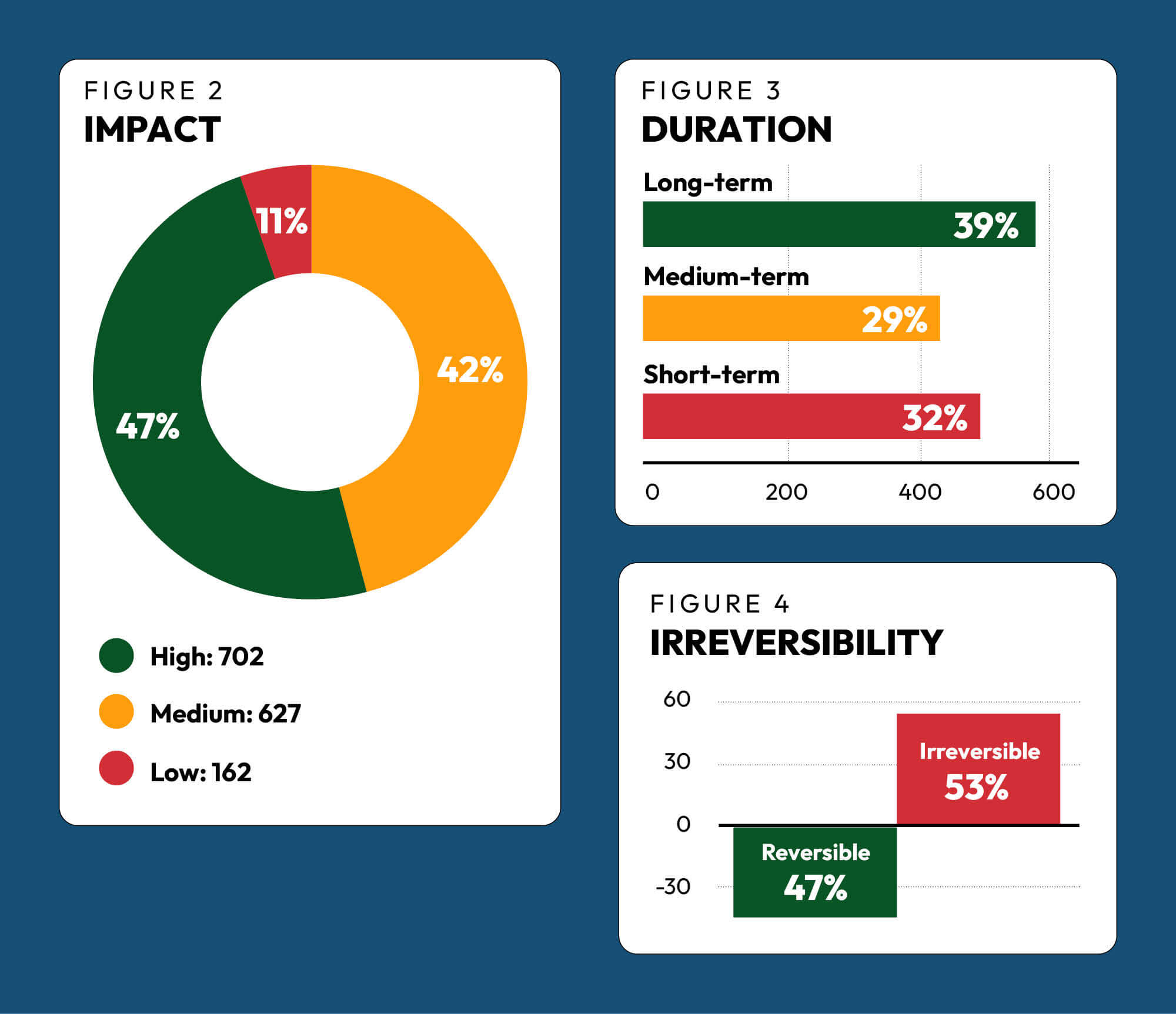
In terms of impact, almost half (47%) were seen to have high impact, followed by 42 per cent being considered to have medium impact. Eleven per cent were considered to have low impact. One activity was evaluated to have no impact at all (Figure 2).
In terms of the possibility of the activities being continued, 9 in every 10 activities were considered as having the likelihood of being continued. This is a positive outcome and shows that the activities undertaken are not one-off activities. It also indicates that sustainability has been a key consideration when activities were being planned.
As to when the effects of an activity would be felt, the results are spread across the periods: short-term, medium-term, and long-term, 32 per cent, 29 per cent and 39 per cent, respectively, with long-term having the greatest proportion and medium-term having the least (Figure 3). Should one look closely at the activities for each of the sections of the APSC Blueprint 2025, more than half of the activities under the Rules-Based, People-Oriented, People-Centred Community (52%) have been assessed to have their effects felt over the short-term. In contrast, 50 per cent of the activities under the sections Peaceful, Secure and Stable Region and 52 per cent of those in ASEAN Centrality in a Dynamic and Outward-Looking Region have been assessed to have their effects felt over the long-term. ASEAN’s goal of having a rules-based, people-oriented, people-centred community is immediate. The goal of having a peaceful, secure and stable region, as well as ensuring ASEAN Centrality, are long-term undertakings.
While 53 per cent of the activities were viewed as having irreversible effects, 47 per cent were seen to have their effects as reversible (Figure 4). The proportion of activities whose effects are seen as reversible is nearly the same as the proportion of activities whose effects are seen as irreversible.
In terms of the probability of the intended effects happening, it is worth noting that the combined proportion of those having their effects definitively and probably happening is 71 per cent (34 and 37 percent, respectively). Twenty-six per cent (26%) were viewed as having their effects possibly happening. A mere 3 per cent were seen to have their effects unlikely to happen.
The implementation of the APSC Blueprint 2025 has brought forth two separate but interrelated issues. One is the alignment of Sectoral Action Plans and/or Workplans with the APSC Blueprint 2025 itself. The other one is the nexus of efforts of APSC Sectoral Bodies and actions at the national level by the ASEAN Member States.
Ideally, Sectoral Action Plans and/or Work Plans should be aligned with the APSC Blueprint 2025. The Blueprint’s action lines provide the framework and serve as the guidepost, while the Sectoral Action Plans and/or Work Plans identify how the contents contained in the Blueprint’s action lines are operationalised.
Given that the APSC Blueprint 2025 “outlines broad goals for the political and security community, while sectoral bodies [are] focused on translating these into specific actions within their respective areas…, plans of action and work plans should be aligned with the APSC Blueprint.” Another ASEAN Member State reinforced this view by saying that “alignment of sectoral plans with the APSC Blueprint 2025 [is] essential for regional cohesion and effectiveness.”
On the nexus between sectoral efforts and national actions, Sectoral Bodies’ approaches have complemented national-level undertakings by “translating broad policy goals into concrete, actionable initiatives within specific areas of cooperation.” As one ASEAN Member State put it, “common frameworks and standard regional guidelines,” including action plans developed by Sectoral Bodies, provided ASEAN Member States with “a shared reference point.”
The case of sectoral strategies being implemented nationally but reviewed regionally implies that efforts of implementation are predominantly at the national level. It is said that “national leadership will remain essential but sectoral bodies…can play an increasingly important role in providing expertise and regional coherence.” For technical and cross-border issues, there is “merit in a more sectoral-based approach, with sectoral bodies taking the lead in coordination and implementation, but within a hybrid model that maintains close alignment with ASEAN Member State-led inputs to ensure national ownership.”
On ASEAN Centrality
Amidst the current geo-political and geo-economic challenges, ASEAN Centrality remains as the linchpin of ASEAN Community-building as well as ASEAN’s external relations, providing ASEAN with a “strong foundation” of its “external relations and strategic positioning in the evolving regional landscape.” It enables ASEAN to “safeguard regional interests while benefitting from international cooperation.” However, ensuring and promoting ASEAN Centrality could likewise be a challenge.
ASEAN’s external relations has expanded significantly over the past ten years, both in terms of accession to the Treaty of Amity and Cooperation in Southeast Asia (TAC) and formal partnerships.
In addition to the number of ASEAN’s dialogue partners having increased to 11 with the UK becoming one in 2021, it is also within this period that several of ASEAN’s Dialogue Partners, which were already Strategic Partners, became Comprehensive Strategic Partners, a manifestation of their robust cooperation with ASEAN. These are Australia and China in 2021, the United States and India in 2022, Japan in 2023, the Republic of Korea in 2024, and New Zealand in 2025.
Equally important to highlight is the adoption of the ASEAN Outlook on the Indo-Pacific (AOIP) in 2019. Amidst the then already increasing competition among the major powers, ASEAN adopted the AOIP to reinforce the inclusive approach to cooperation that ASEAN has promoted through the years. The AOIP, with its principle of inclusivity at its core, has since become a key reference framework for cooperation between ASEAN and its external partners and has consistently gained support from ASEAN’s external partners.
Conclusion and moving forward
The good progress made in ASEAN Political-Security Community-building is attested to by the fact that the region has remained peaceful, secure and stable. The centrifugal forces of political, security, economic, and socio-cultural challenges, both traditional and non-traditional, from the intensifying geopolitical and geoeconomic competition among major powers to the effects of climate to public health emergencies to problems in the digital world, could have pulled the ASEAN Community apart. However, ASEAN, being the centripetal force, has kept the region together. ASEAN has remained the locus of identity for its members and continues as the fulcrum of cooperation with external partners.
The goals set forth in the APSC Blueprint 2025 have therefore been achieved, even if sectoral action plans and/or work plans do not perfectly align with the APSC Blueprint. Achieving the goals is a result of the complementarity between sectoral action plans and/or work plans on the one hand and national efforts on the other hand. The Implementation of the APSC Blueprint 2025 was underpinned by enhanced institutional capacity and effectiveness, which was also one of the goals set forth in the Blueprint. Meanwhile, efforts have been made to keep the APSC Blueprint 2025 adaptive and responsive to the changing strategic environment. ASEAN has taken strides to ensure that ASEAN Centrality is ensured, promoted and supported by its external partners as it pursued its Political-Security Community-building for the past 10 years.
Notwithstanding the successful implementation of the APSC Blueprint 2025, challenges were encountered along the way in terms of resources, capacity-building and even monitoring progress, promoting cross-pillar and cross-sectoral coordination, and cascading the APSC Blueprint 2025 and its activities beyond the policy level to the ground. These challenges, while serving as constraints, nonetheless allowed or paved the way for lessons to be learned—lessons that will be useful references as ASEAN moves towards the next stage of implementing the new APSC Strategic Plan to realise what is envisioned in the ASEAN 2045: Our Shared Future.
The article is adapted from the APSC Blueprint 2025 End-Term Review Report, which was approved by the 30th APSC Council Meeting on 25 October 2025.