
In 2015, as UN member states adopted the 2030 Agenda for Sustainable Development, the Philippines made an additional commitment to conduct a Voluntary National Review (VNR) on Sustainable Development Goals (SDGs) every three years. With the Department of Economy, Planning, and Development (DEPDev) serving as Chair and Secretariat to the Philippine Subcommittee on the SDGs (SC-SDG), we have produced four VNRs, published in 2016, 2019, 2022, and 2025.
O
ur fourth VNR provides a comprehensive assessment of the country’s progress toward achieving the SDGs, based on 2024 data. It highlights actions taken in response to commitments made in the third VNR, with an emphasis on innovative statistical developments pursued to enable data-driven interventions.
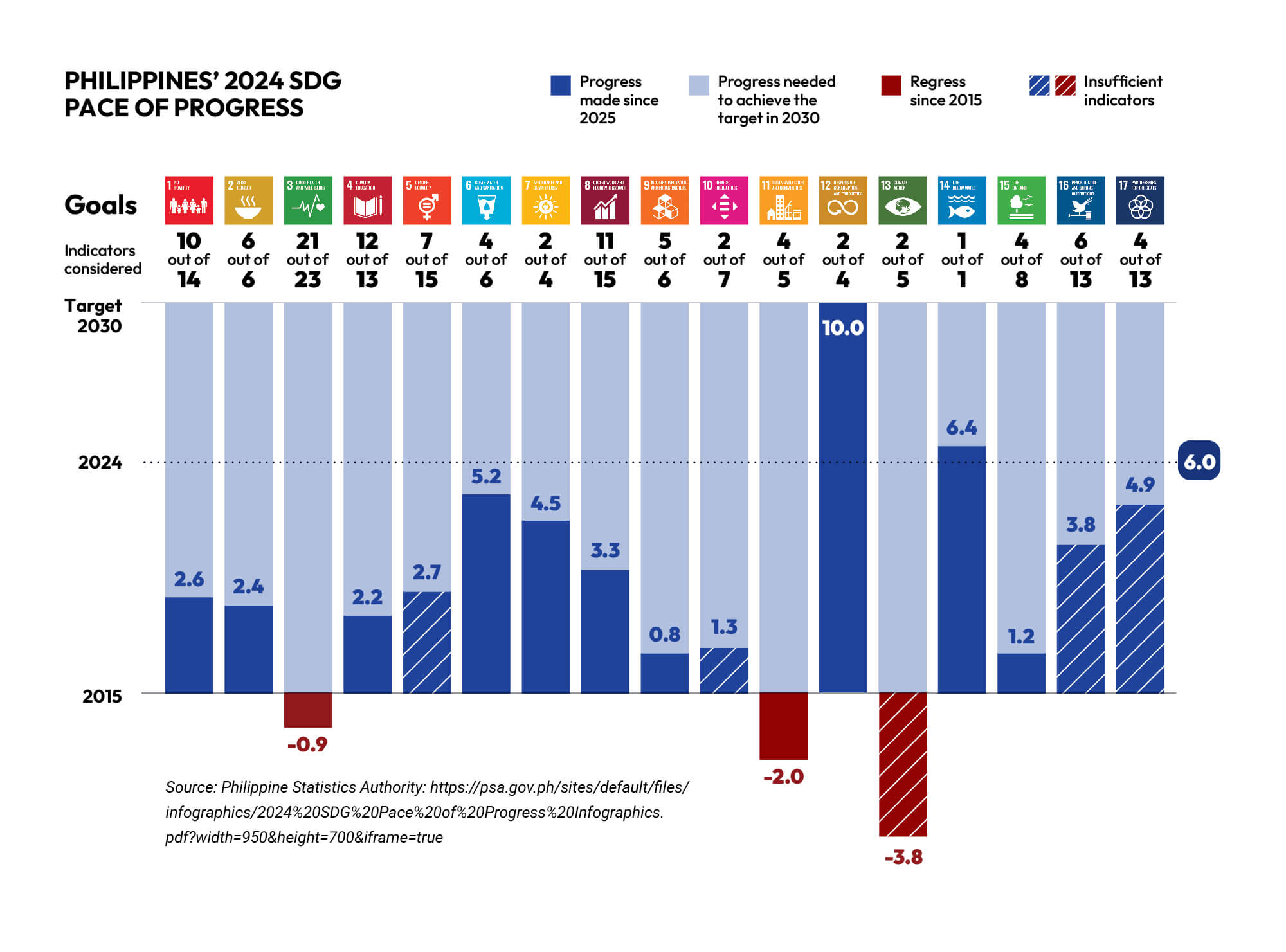
Guided by AmBisyon Natin 2040, our long-term vision of a strongly rooted, comfortable, and secure life for all Filipinos, and with the Philippine Development Plan as our blueprint, the country has made notable progress across 10 SDGs.
The Philippines’ 2024 SDG Pace of Progress reported gains in the following goals: Goals 1 (No Poverty), 2 (Zero Hunger), 4 (Quality Education), 6 (Clean Water and Sanitation), 7 (Affordable and Clean Energy), 8 (Decent Work and Economic Growth), 9 (Industry, Innovation, and Infrastructure), 12 (Responsible Consumption and Production), 14 (Life Below Water), and 15 (Life on Land). These represent a complete reversal of the setbacks noted in SDGs 2, 7, 8, and 9 under the 2022 Pace of Progress.
Key initiatives to accelerate SDG implementation
Building on the 2022 VNR, the Philippines leveraged the whole-of-nation plus approach to implement and report the country’s progress toward the 2030 Agenda for Sustainable Development and its SDGs. This approach fosters meaningful collaboration and partnerships across national and local governments (“whole-of-government”) and non-government stakeholders (“whole-of-society”), aligning resources and initiatives in a unified effort to advance sustainable development. The “plus” component further strengthens this approach through innovation and futures thinking, as well as strengthened international cooperation for the SDGs. This added component will help build a more resilient and sustainable future in the post-pandemic era.
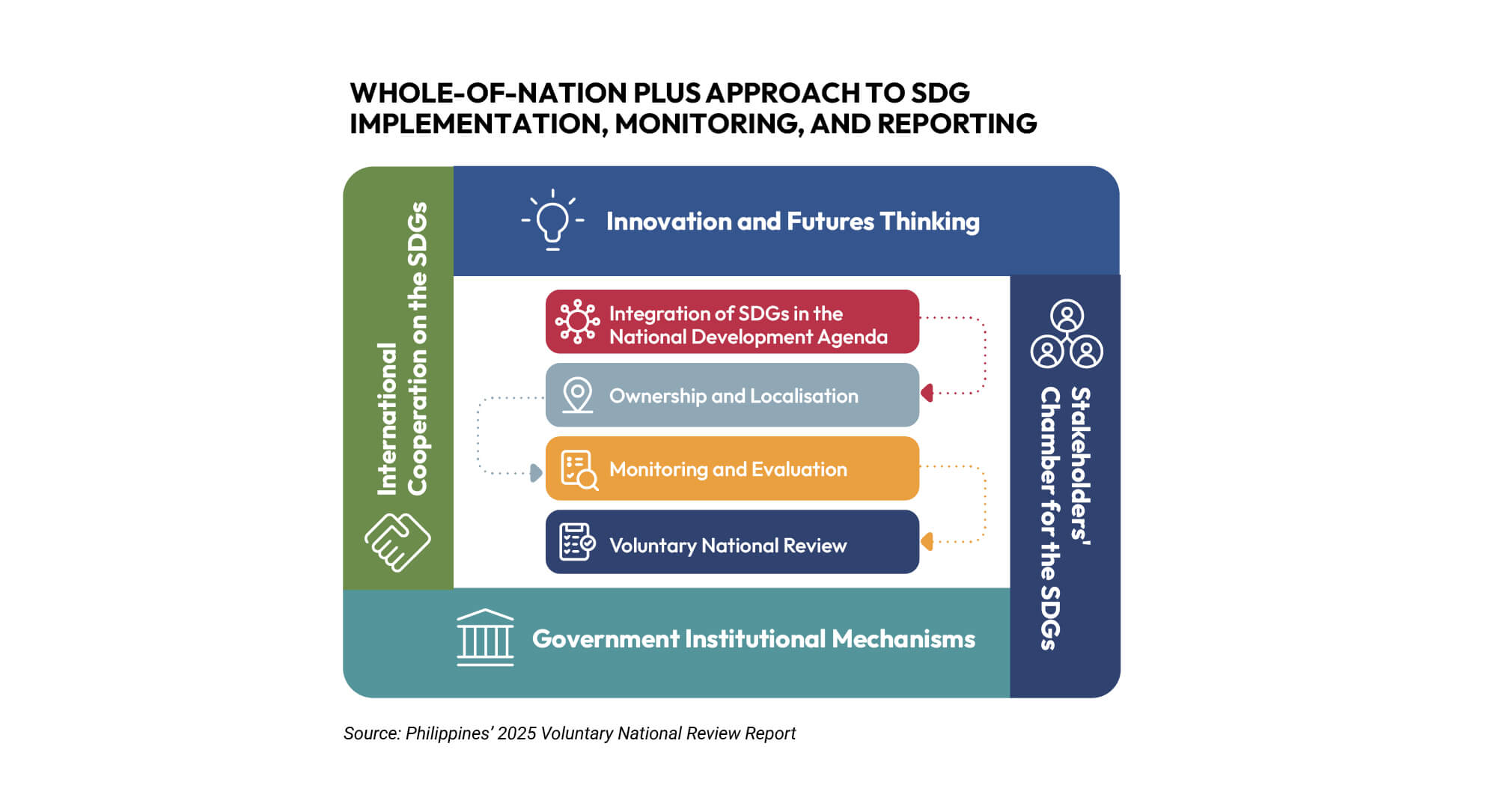
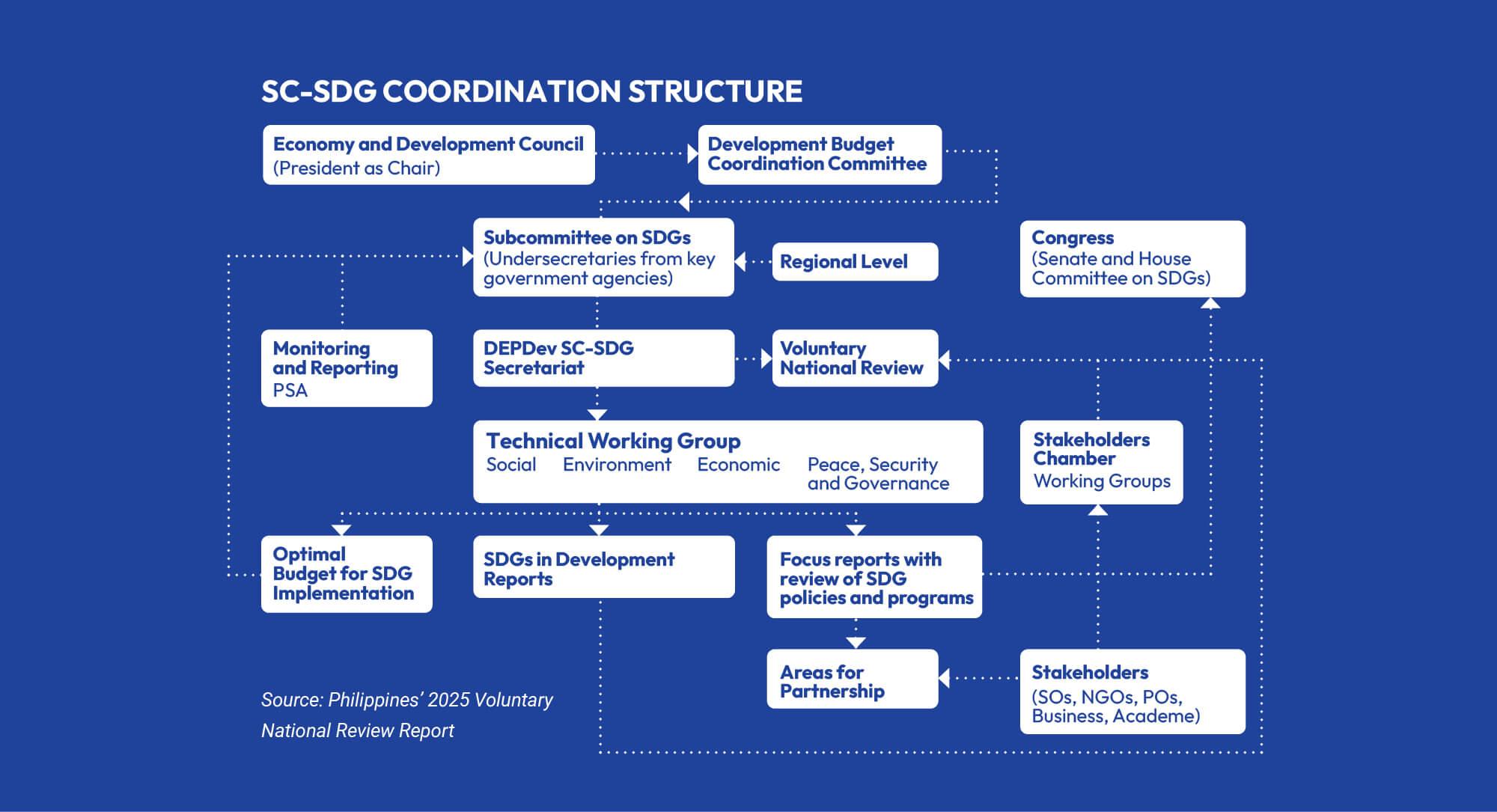
We strengthened institutional mechanisms like the SC-SDG, its sectoral Technical Working Groups (TWGs), and the Stakeholders’ Chamber for the SDGs (Chamber). Established in 2019, the SC-SDG and its TWGs serve as dedicated inter-agency bodies that steer and coordinate government efforts to implement the SDGs. As the non-government counterpart, the Chamber actively contributes to policymaking, implementation, advocacy, and SDG review. It demonstrates its commitment through a three-year roadmap that outlines strategic milestones and objectives for policy recommendations, monitoring and evaluation, coordinated action, and strategic communications.
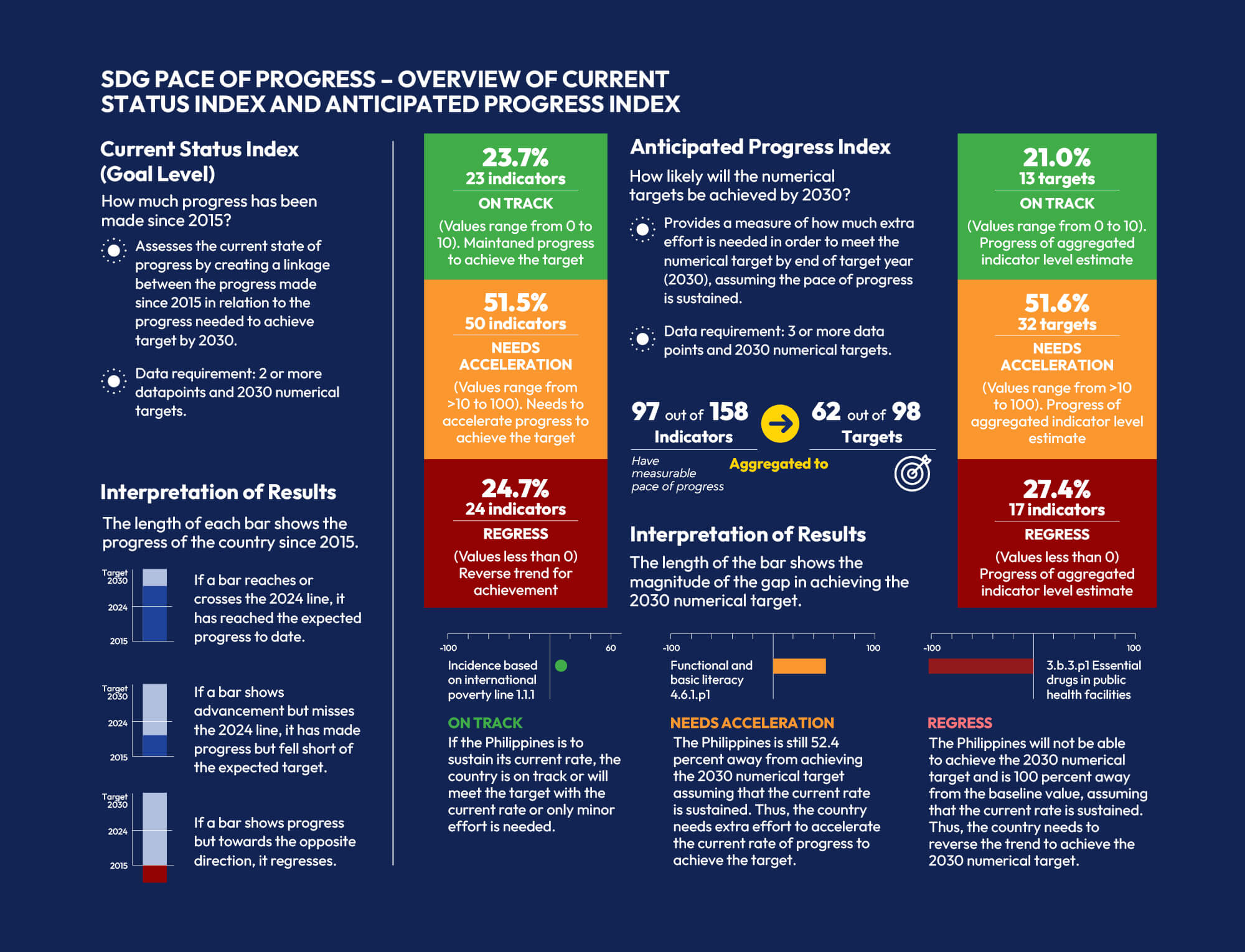
Statistical innovations drive the country’s initiatives and accomplishments in implementing data-driven interventions. These include the SDG Pace of Progress, SDG Watch, and SDG Data Platform, among others. The Philippine Statistics Authority (PSA) produces the SDG Pace of Progress, offering a snapshot of national performance on each goal since the adoption of the 2030 Agenda in 2015. The PSA also monitors the country’s SDG Indicator Framework through the SDG Watch, updated annually with data submitted by national government agencies. To streamline this process and lessen the reporting burden, the PSA developed the SDG Data Platform—an automated, real-time system for compiling and managing SDG data online.
Localising SDG initiatives
DEPDev has led the strategic and coordinated effort to localise the 2030 Agenda by addressing specific development gaps and regional disparities in SDG progress through the Regional SDG Catch-up Plans. The initiative began with three pilot regions—Regions III, VIII, and SOCCSKSARGEN—representing each major island group in the country.
To support evidence-based policymaking, DEPDev developed the SDG Progress and Assessment Tool and partnered with the UN Economic and Social Commission for Asia and the Pacific in utilising the Every Policy Is Connected (EPiC) Tool. These tools helped identify priority areas and guide the formulation of the plans.
DEPDev and the Regional Development Councils (RDCs) jointly monitor and implement the plans through a multi-layered, data-driven process that ensures accountability and enables timely course corrections to accelerate SDG progress at the regional level.
Boosting SDG financing
The national budget of the Philippine government is embodied in the General Appropriations Act (GAA), which Congress enacts annually. The country aligns the entire national budget and its expenditure priorities with the Philippine Development Plan, in which the SDGs have been mainstreamed. To augment GAA allocations for SDG-related initiatives, Congress enacted Republic Act No. 11467, amending the National Internal Revenue Code of the Philippines. Section 9 of the law mandates that 20 per cent of the total revenues collected from excise taxes on alcohol, heated tobacco, and vapour products should be allocated to initiatives that support the achievement of the SDGs.
DEPDev led the adoption of the Program Convergence Budgeting approach for the SDGs (PCB-SDG). The PCB-SDG Framework outlines the guidelines, evaluation processes, prioritisation criteria, and administrative procedures for identifying key programmes, projects, and activities that contribute to achieving the SDGs.
The country’s Innovation Fund also plays a pivotal role in accelerating SDG progress by supporting creative, scalable solutions to complex global challenges. Since 2022, innovation grants have enabled local government units and state universities and colleges to establish or enhance innovation infrastructure and to develop innovative tools for key sectors, such as education, transportation, food and agribusiness, medical sciences, security and defense, and the blue economy.
Accelerating the path to 2030: The Philippines’ commitment to the SDGs
With 2030 on the horizon, the Philippines is implementing forward-looking strategies that promote inclusive, resilient, and sustainable development. The government is intensifying international cooperation by deepening engagement with multilateral and bilateral partners, mobilising resources, and advocating for fair access to global financing. It also seeks to strengthen regional economic ties to ensure long-term support for sustainable development initiatives.
To enhance SDG monitoring, the country is advancing integrated reporting by reinforcing linkages between national, subnational, and local reviews. The national government, led by the Department of the Interior and Local Government, in collaboration with local government leagues and UN agencies, has established mechanisms to track which local government units are conducting Voluntary Local Reviews (VLRs), along with facilitating dialogue to create synergies between national and local SDG efforts and encouraging more local governments to undertake VLRs.
The Philippine government also fortifies environmental resilience by implementing landmark legislation that focuses on ecosystem protection, rehabilitation, restoration, and sustainable management. These efforts strengthen the capacity of national and local institutions to prevent, reduce, and manage the impacts of climate change more effectively.
As the Philippines charts its path toward 2030, it remains steadfast in transforming ambition into action. By harnessing innovation, strengthening partnerships, and empowering local communities, the country is not only accelerating SDG progress but it is also shaping a future where no one is left behind. With bold leadership and a shared vision, the Philippines stands ready to deliver on the promise of sustainable development—resilient, inclusive, and enduring.
The views and opinions in this article are solely those of the author and do not represent the policy or official position of ASEAN.