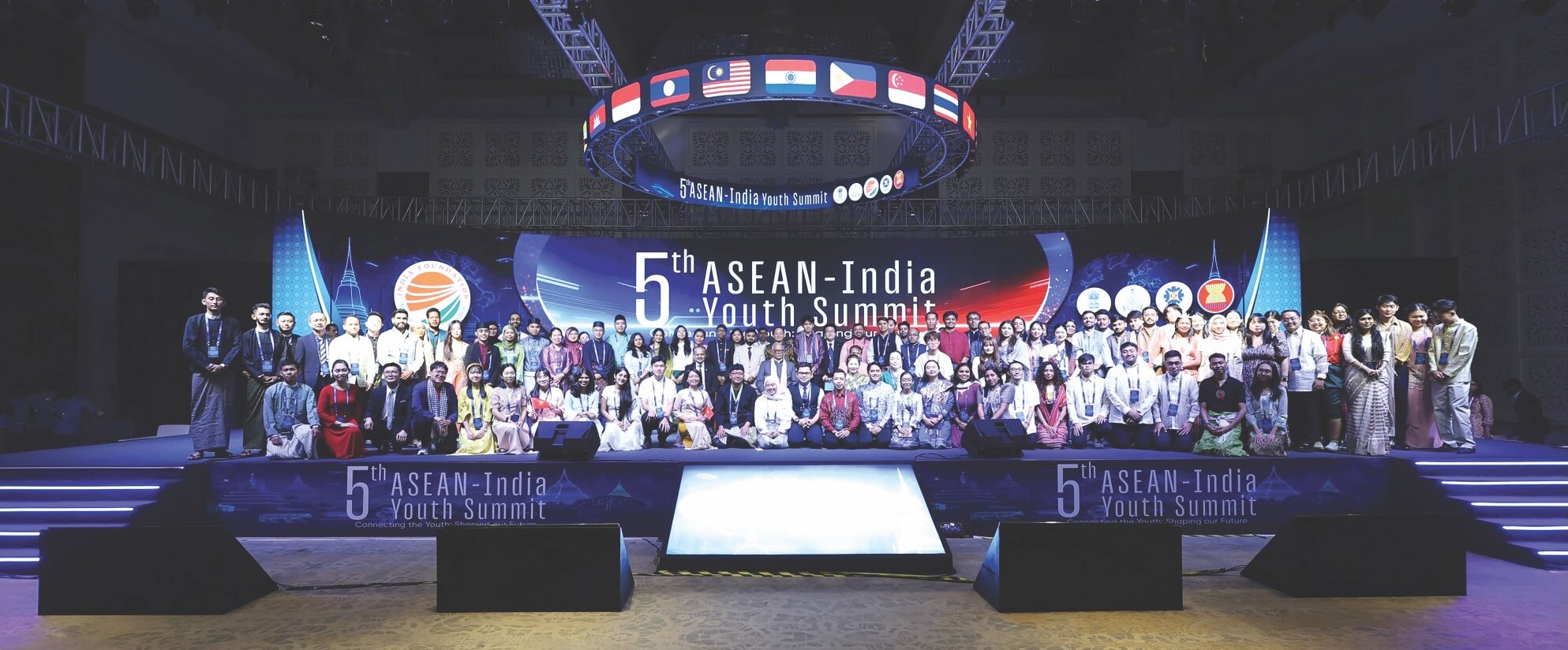

Goa, India, where easy days drift into lively nights, has attracted countless travellers for generations, making it a perfect place to gather young minds. It was fi tting that this storied destination hosted the 5th ASEAN-India Youth Summit in the ASEAN-India Year of Tourism. Held from 27 to 31 August 2025, the summit was organised by India Foundation in collaboration with the ASEAN Foundation and supported by the Ministry of External Affairs, Government of India, the State Government of Goa, and the ASEAN Secretariat. It brought together about one hundred young leaders from India and the ASEAN Member States under the theme “Connecting the Youth: Shaping our Future.”
In his video-recorded opening remarks, Secretary-General of ASEAN, Dr. Kao Kim Hourn, noted that ASEAN counts roughly 224 million young people and India about 345 million—a combined cohort of more than 500 million with the power to shape the future. He linked the summit to ongoing ASEAN- India work on climate action, digital transformation, education, connectivity, and inclusive growth. He urged delegates to welcome diverse views and turn ideas into action. “Your ideas, your passion, your relentless optimism—these are the forces that will propel ASEAN-India cooperation forward. Thank you for showing up, for speaking up, and for pushing the boundaries of what’s possible. Your active engagement in these discussions advances the broader objectives of ASEAN-India cooperation and fosters your indispensable role as co-creators of our region’s future.” Meanwhile, Union Minister of State for External Affairs and Textiles, Shri Pabitra Margherita, opened the event by using himself as an example of India’s closeness to ASEAN, both in geography and culture. “I hail from India’s Northeast, and you may be surprised how close I am to ASEAN countries,” he said while welcoming delegates. His hometown of Margherita in Assam, he explained, is about 170 km to Myanmar and roughly 1,600 km to Thailand. By comparison, Goa is around 2,600 km away, and even the state capital, Guwahati, is 550 km distant. Margherita underscored shared ASEAN- India values and invited young leaders to contribute to the ASEAN Community Vision 2045 and the Sankalp of Viksit Bharat. In a fast-changing, often volatile world, he noted that the collective efforts of young people can deepen the ASEAN-India comprehensive strategic partnership and carry it through uncertainties. “You are the critical thinkers, changemakers, innovators, communicators, and leaders. I hope your discussions at this summit will give you deeper insights that contribute to strengthening our cooperation.” Dr. Kao echoed this sentiment and urged delegates to spark real change. “Here’s my challenge to you: don’t let this summit be just another event in your calendar. Make it the catalyst for the change you want to see. Build those networks, yes, but more importantly, build movements. Stay connected not just through social media but through shared purpose. Seize this opportunity to explore collaborative possibilities and remain actively engaged in youth initiatives long after this event concludes.”
Platform for sharing ideas and shaping the future
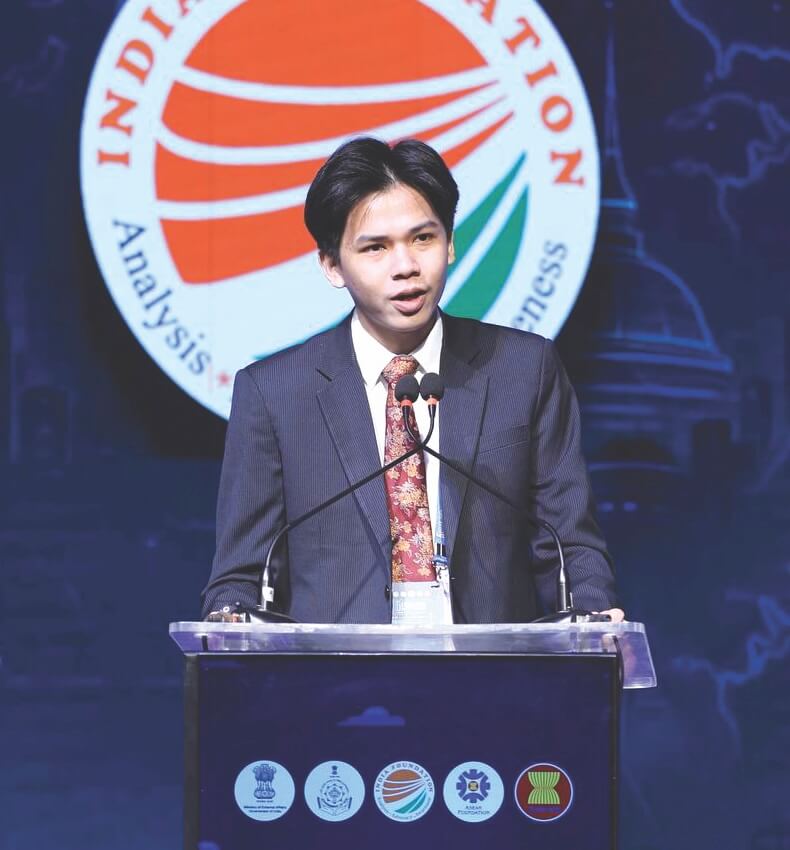
Young leaders and changemakers at the fi fth ASEAN-India Youth Summit came from politics, technology, academia, media, and think tanks. They met for focused conversations, practical collaboration, and network building to address shared challenges and chart a stronger future. Among them was 22-year-old delegate Pheng Thean. With a strong interest in regional security and foreign policy, he now works as a Research Associate at the Asian Vision Institute (AVI) in Phnom Penh. During Cambodia’s country presentation, he spoke about how young people are perceived and engaged across government, parliament, and grassroots settings. “Cambodian youth are deeply involved in the policy development process, from youth councils to online consultations and workshops. They are no longer passive observers but active partners in shaping the nation’s future. Young people now stand at the heart of Cambodia’s transformation, driving the country toward its Vision 2050 and contributing to the broader goals of ASEAN 2045,” he conveyed. For Pheng, the summit is an important platform to express views, share experiences, and engage directly with regional issues that affect the future. He also highlights the people-to-people side: shared meals, time to mingle, and tours. “The best part of the event was definitely the chance to engage in meaningful dialogue with young leaders from across ASEAN and India. I really enjoyed the open discussions, the cultural exchange, and even the simple moments like sharing meals and mingling; those experiences made the connection more genuine. And indeed, I won’t forget all the curry and fish,” said Pheng. In the summit handbook, Dr Shristi Pukhrem, Deputy Director (Academics and Research) at the India Foundation, notes that the meeting’s spirit aligns with ASEAN’s approach to cooperation. She adds that declaring 2025 the ASEAN-India Year of Tourism offers a practical bridge for youth networks through travel and cultural exchange. “This approach aligns with ASEAN’s own vision of maintaining centrality in regional architecture while fostering inclusive, rules-based cooperation across the Indo-Pacific,” she added.