

Inclusivity is not just rhetoric in ASEAN's new 20-year vision; it is written into the political, economic, and socio-cultural strategic plans that will shape Southeast Asia through 2045.
“We shall place the ASEAN peoples at the heart of our efforts and ensure the meaningful and inclusive participation of all stakeholders in our ASEAN Community-building process,” states the ASEAN Community Vision 2045, adopted by the ASEAN Leaders at the 46th ASEAN Summit.
Why inclusivity is essential
Secretary-General of ASEAN, Dr. Kao Kim Hourn, defined inclusivity as “ensuring that every country, every community, and every individual has a meaningful voice in shaping our common future,” in his opening remarks at the 58th ASEAN Day celebration on 8 August 2025 in Jakarta. He emphasised that development should reach the remotest village, empower women and youth, and leave no one behind. ASEAN recognises that there are still segments of the population that remain deprived of opportunities, rights, and resources to participate fully in society and lead fulfilling lives—either because of age, gender, socio-economic status, disability, or geography, or a combination of these factors. ASEAN’s pursuit of inclusive measures aims to dismantle systemic inequalities and deliver social justice to the region’s most vulnerable sectors and communities. Beyond fulfilling its social responsibility, ASEAN strives for an inclusive Community for its undeniable economic benefits. When people have meaningful jobs and have access to healthcare and social protection, poverty is reduced, productivity and income are higher, and people are empowered to shape their own social and economic futures.
For example, data show that closing gender gaps could increase the collective GDP of Southeast Asian economies by as much as 370 billion US dollars annually (Mckinsey, 2018). Making jobs equally accessible to persons with disabilities (PWDs) could boost the GDP of Asia-Pacifi c countries by up to 7 per cent (UNESCAP, n.d.).
Laying the foundations for an inclusive ASEAN Community
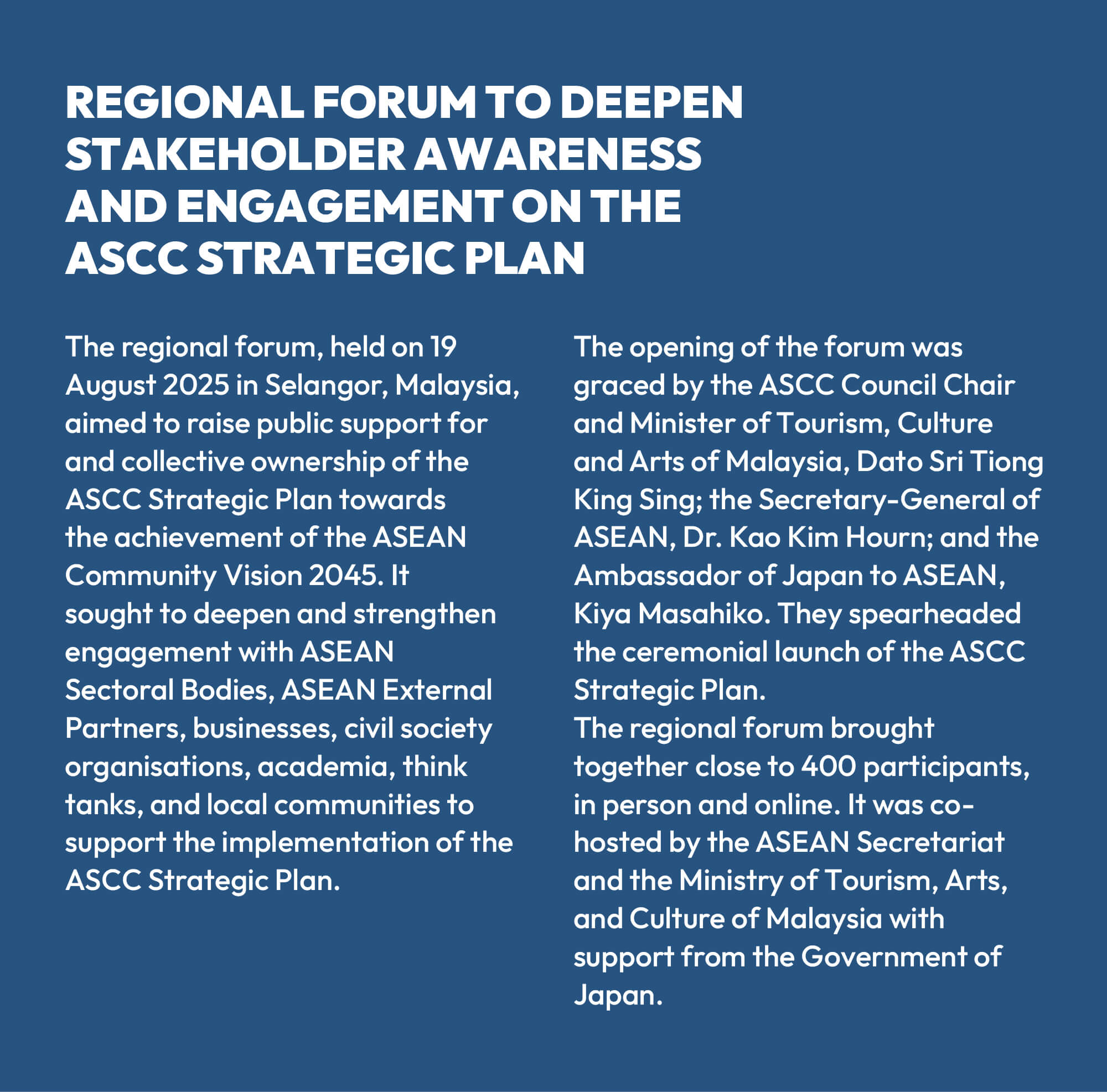
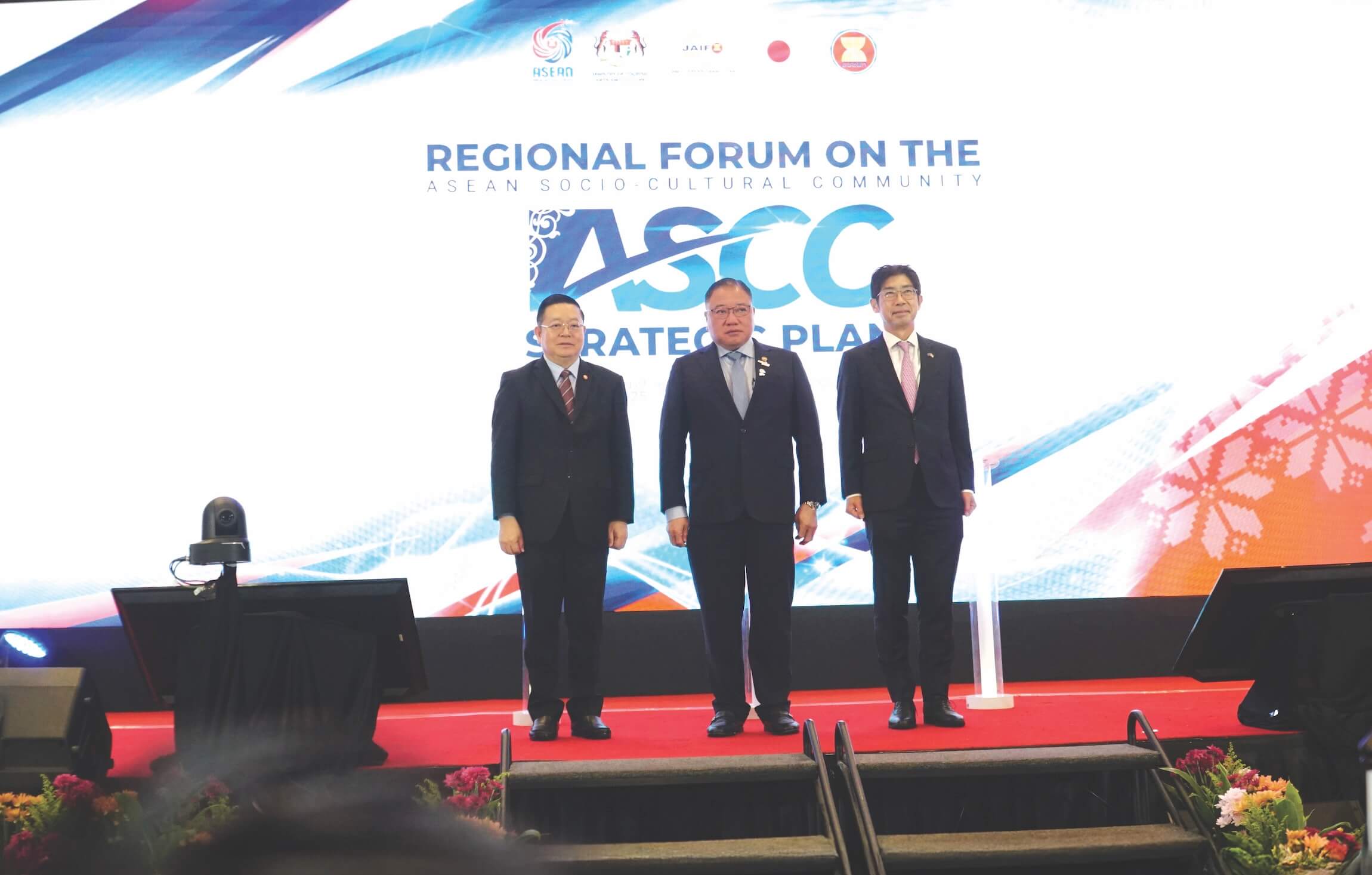
The groundwork for an inclusive community was laid through the ASEAN Community Vision 2025, which guided the region’s work from 2015 to 2025. It has informed the plans and initiatives of the different ASEAN Community pillars and their sectoral bodies to date. The ASEAN Socio-Cultural Community (ASCC) showcased its ongoing inclusive initiatives at the recently held Regional Forum to Deepen Stakeholder Awareness and Engagement on the ASCC Strategic Plan.
Persons with disabilities
“For PWDs, our guiding framework is the ASEAN Enabling Master Plan 2025,” said Hajah Nor Ashikin binti Haji Johari, Chair of the Senior Offi cials Meeting on Rural Development and Poverty Eradication (SOMRDPE) and Senior Offi cials Meeting on Social Welfare and Development (SOMSWD). Overall, she noted that 71 per cent of the measures under the master plan have been largely completed or have seen signifi cant action. “The ASEAN Political-Security Community (APSC) reported the highest level of completion at 88 per cent. The APSC sectoral bodies have organised numerous trainings and workshops across the region and educated communities about the fundamental rights of PWDs, including their right to participate in decision- making processes and engage in public and political life.” Ms. Nor Ashikin said that the ASCC, for its part, has achieved an 87 per cent completion rate. “(We see) signifi cant progress in ensuring social protection and access to services, as well as participation in decision-making for persons with disabilities. We also see tangible progress at the national level: enacting new laws, developing national strategies, and enhancing accessibility in critical areas.” Meanwhile, the implementation of inclusive measures under the ASEAN Economic Community (AEC) fell short at only 37 per cent. “This is critical, as you know, economic empowerment, employment, and entrepreneurship are very much fundamental in ensuring inclusion and bridging (the) development gap,” said Ms. Nor Ashikin. Ms. Nor Ashikin said that the new vision, as well as the outcome of the master plan’s review, will steer the development of a successor plan.
Rural communities
Ms. Nor Ashikin said the region’s commitment to inclusive rural development is refl ected in the ASEAN Framework Action Plan on Rural Development and Poverty Eradication 2021-2025 as well as the ASEAN Master Plan on Rural Development 2022-2026. The plans prioritise supporting rural and farming communities not only to lift them out of poverty but also to ensure broader food security. “Our rural communities are the bedrock of our region’s food supply, with smallholder farmers producing up to 8 per cent of food supply in some Member States,” Ms. Nor Ashikin said. This support takes the form of strengthening rural infrastructure, promoting sustainable land management, and advancing climate- smart agricultural practices, among other measures. ASEAN is also pursuing the expansion of the ASEAN Villages Network. Launched in 2023, it aims to form a network of villages across the region to facilitate knowledge sharing, capacity enhancement, partnership development, and policy advocacy. “We believe that the ASEAN Villages Network has signifi cant potential to accelerate community-driven development, cultural preservation, and creative economies if expanded and properly funded,” said Ms. Nor Ashikin.
The plans’ formulation itself follows an inclusive approach with SOMRDPE tapping the Asia DHRRA to help develop its two action plans (2011-2015 and 2021-2025) and the ASEAN Master Plan on Rural Development 2022-2026. “To some extent, we have contributed to making ASEAN plans become people-oriented, with representatives from rural people’s organisations and civil society organisations present during the national consultations,” said Ms. Marlene Ramirez, Asia DHRRA Secretary General.
Older persons, women, and populations in vulnerable situations
To accelerate vulnerable groups’ social inclusion, ASEAN is working to implement the ASEAN Declaration on Strengthening Social Protection. “It focuses on key strategic measures, including improving social insurance for formal and informal workers, expanding social assistance for the poor and vulnerable, and increasing access of persons with disabilities, the elderly, and children to social services,” Ms. Nor Ashikin explained. With older persons representing 7.5 per cent of the regional population in 2022—a fi gure expected to reach 16. 3 per cent by 2050—providing support for older persons is also a top concern. “Our efforts are guided by key regional instruments such as the Kuala Lumpur Declaration of Ageing: Empowering Older Persons in ASEAN and the ASEAN Comprehensive Framework on Care Economy,” said Ms. Nor Ashikin. The region has also taken steps to promote active and healthy ageing, said Dr. Ismuni Bin Bohari, Chair of the Senior Offi cials Meeting on Health Development (SOMHD), and Mr. Suguru Ito of the ASEAN Centre for Active Ageing and Innovation (ACAI). This approach serves the dual purpose of building a more age-inclusive society while reducing healthcare burden. The ASEAN Comprehensive Framework on Care Economy was likewise developed to alleviate women’s disproportionate care responsibilities and support their inclusive participation in the workforce, alongside maximising the economic potential of care work. “Strengthening the care economy is essential moving forward for inclusive growth, social welfare, and gender equity,” said Ms. Nor Ashikin.
ASEAN 2045: Paths to inclusivity
Integrating inclusivity into all aspects of the new strategic plans of the APSC, AEC, ASCC, and Connectivity underscores the regional bloc’s unyielding commitment to deepening its inclusive practices and outcomes and building on its decade-long progress. In the plans, digital inclusion stands among the strategies cited for attaining an inclusive ASEAN. “We see digital inclusion as offering a pathway to reducing disparities, empowering marginalised communities, and fostering a more cohesive regional identity,” said Ms. Nor Ashikin. The AEC Strategic Plan seeks to address digital divides and facilitate MSME participation in the digital economy. The ASCC Strategic Plan focuses on harnessing digital technologies to empower the vulnerable and marginalised and protect women and children from harm. The Connectivity Strategic Plan supports the expansion of digital access in underserved areas and cross-border mobility of students, workers, and digital talent. The plans have also positioned the creative economy as a source of growth and inclusivity. “The creative economy offers ASEAN a unique pathway to advance inclusive development and bridge the development gap. Its people- centric nature enables participation across the different age groups, gender, and geographic locations,” said Dato’ Mohd Yusri bin Mohd Yusoff, Deputy Secretary General of Malaysia’s Ministry of Tourism, Arts and Culture. The ASCC Strategic Plan seeks to expand the access of women, youth, rural communities, and cultural workers to creative industries; invest in skills training; and promote entrepreneurship. The AEC Strategic Plan will pursue policies and initiatives that support the creative sectors, such as arts, media, design, and digital content. The four strategic plans also uphold inclusivity as a participatory process with different sectors, communities, and stakeholders actively involved in policy discussions and decision-making processes. The APSC Strategic Plan will advance this commitment by promoting people’s participation in advancing human rights and by strengthening ASEAN Centrality while keeping an actively engaged, outward-looking, inclusive, and non- discriminatory approach to external relations. The AEC Strategic Plan aims to reinforce the inclusive process by forming partnerships with different stakeholders to share the benefi ts of growth and holding public consultations and surveys to integrate citizen perspectives into economic planning. An inclusive ASEAN Community is within reach, but only if ASEAN works resolutely and collectively in the next two decades to turn these ambitious strategic plans into reality.
For further reading: ASEAN Secretariat. (2025). ASEAN 2045: Our Shared Future. https://asean.org/wp-content/uploads/2025/05/ASEAN-2045-Our-Shared-Future.pdf